20Coffee LabAPRIL 26 – MAY 2, 2027
Coffee Lab
Measure it. Change it. Brew it. Taste it.
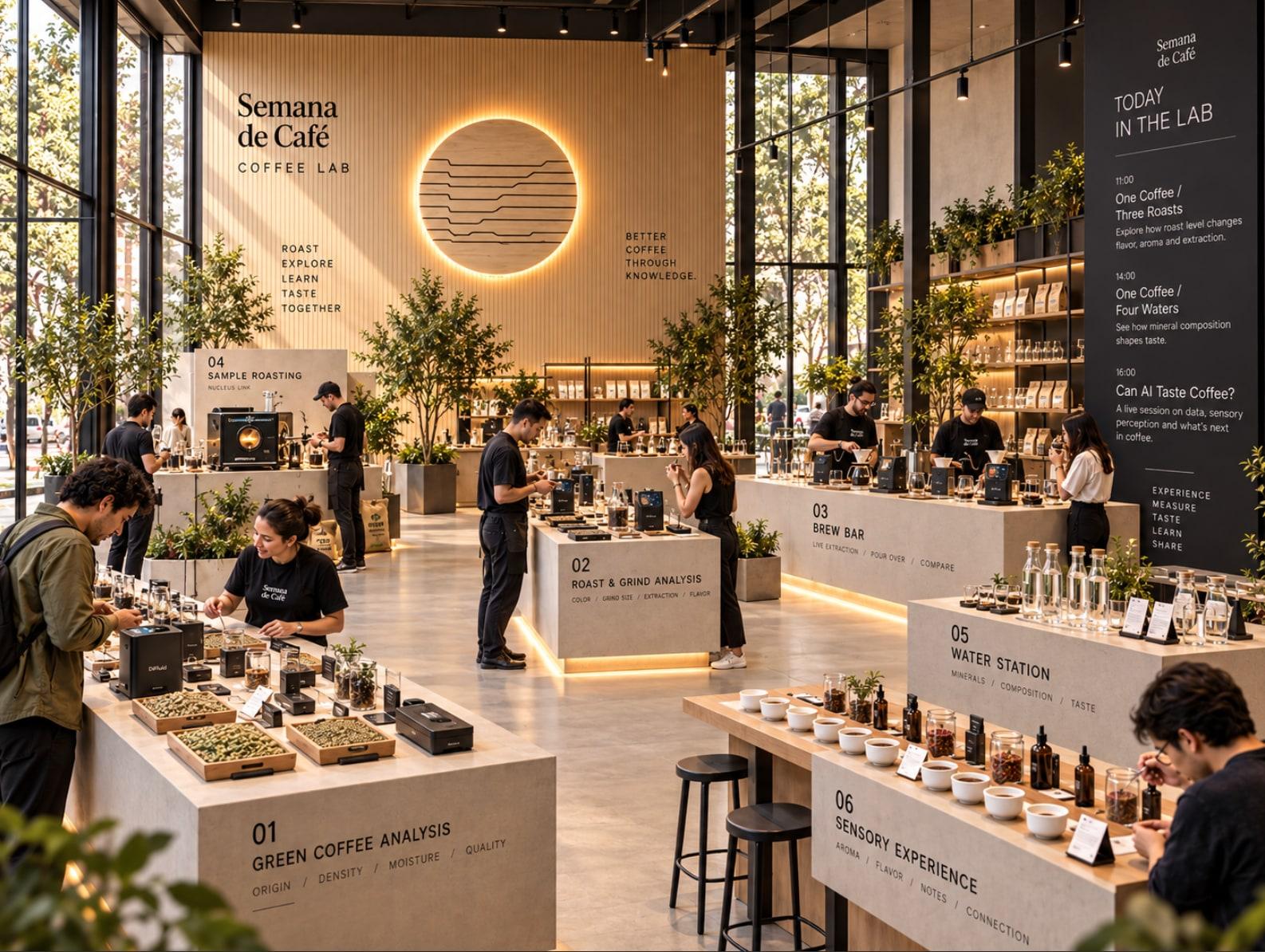
The week's headquarters: an experimental room open all week, where producers, roasters, baristas, researchers, innovators and coffee drinkers explore what happens between green coffee and the final cup. You can walk in without booking.
7 days · CDMX · Semana de Café
Brew Clinic · with or without an appointment
Bring your coffee. Bring your recipe. We'll help you make it better.
Open all 7 days, with or without an appointment. Bring a cup from home, your coffee and your recipe, and leave with an adjusted recipe to try at home.
Lab · 01
One coffee, many variables.
Every cup is the sum of hundreds of decisions, most of them made by people you'll never meet. The Lab lets you pull one of those decisions out, change it, and taste what actually moves.
Follow one coffee from seed to cup. The numbers change at every step.
- Moisture
- 10.8 %
- Water activity
- 0.55 aw
- Density
- 742 g/L
Step 01
Green coffee
Before anything happens to it, the seed already carries its limits: how much water is inside, how dense it is, how evenly it dried.
- Moisture
- 10.8 %
- Water activity
- 0.55 aw
- Density
- 742 g/L
Step 02
Roast
Heat turns a hard green seed into something brittle, brown and aromatic. Two minutes more and the same seed tastes like a different coffee.
- Colour, whole
- 62
- Colour, ground
- 66
- Development
- 20 %
Step 03
Grind
Grinding decides how much surface the water gets to touch. No grinder cuts every particle the same size, and the spread matters as much as the average.
- Median
- 710 µm
- Fines
- 9 %
- Boulders
- 4 %
Step 04
Water
A cup is almost all water, and the minerals in it decide what comes out of the coffee and what stays behind.
- Hardness
- 68 ppm
- Alkalinity
- 40 ppm
- Conductivity
- 160 µS/cm
Step 05
Brew
Temperature, ratio, time, how fast the water moves. A recipe is a set of variables somebody chose, usually by tasting.
- Temperature
- 93 °C
- Ratio
- 1:17
- Time
- 3:10
Step 06
Extraction
How much of the coffee ended up in the cup, and how strong the cup is. Two numbers that explain a lot, and not quite everything.
- TDS
- 1.35 %
- Extraction yield
- 20.1 %
- In the cup
- 223 g
Step 07
Taste
Everything above ends here, in your mouth, where nobody else's number counts. It's the step the Lab never skips.
- Sweetness
- you say
- Acidity
- you say
- Another cup?
- you say
Lab · 02
What you can explore.
Station 01
Green coffee
Two green coffees can look identical on the table and behave completely differently in the roaster.
What's measured
- Moisture
- Water activity
- Density
- Screen size
- Physical consistency
- Processing data
Try this
Two lots, one look. Measure both, roast both the same way, and taste why the numbers disagreed with your eyes.
| What's measured | Lot A | Lot B |
|---|---|---|
| Moisture | 10.4 % | 11.8 % |
| Water activity | 0.53 aw | 0.61 aw |
| Density | 742 g/L | 689 g/L |
| Screen | 16/64″ | 16/64″ |
| Defects / 350 g | 2 | 3 |
Same size, same colour. Not the same coffee.
Station 02
Roast
The same green coffee can be roasted into three different cups. The Lab measures what the roaster did, then asks which one you'd drink again.
What's measured
- Roast colour
- Whole bean vs ground
- Roast uniformity
- Roast development
- Different profiles, same coffee
Try this
One coffee. Three roasts. Which one tastes best?
Whole60
Ground64
- Gap
- 4
- Development
- 20 %
- Drop
- 211 °C
- Minutes
- 10:25
The gap between whole and ground is how evenly the heat got in.
Station 03
Grind
Set two grinders to the same number and they won't agree. The Lab sieves the grounds and measures them by laser to show you how far apart they are.
What's measured
- Particle-size distribution
- Fines
- Boulders
- Grinder consistency
Try this
Same coffee. Same recipe. Different grinder.
- Median
- 710 µm
- Fines
- 9 %
- Boulders
- 4 %
- Drawdown
- 3:10
B drained forty seconds slower. Taste why.
Station 04
Water
Water is the ingredient people forget. Change only its minerals and the same coffee turns flat, sharp, sweet or chalky.
What's measured
- Mineral composition
- Hardness
- Alkalinity
- Conductivity
- Sensory differences
Try this
One coffee. Four waters.
- Hardness
- 68 ppm
- Alkalinity
- 40 ppm
- Conductivity
- 160 µS/cm
- pH
- 7.4
What the textbook predicts
Clear, sweet, structured.
Now taste it.
Station 05
Brewing & extraction
A refractometer tells you how strong a cup is and how much of the coffee it pulled out. It can't tell you how it got there, and the route changes the taste.
What's measured
- Flow
- Temperature
- Brew ratio
- Extraction time
- TDS
- Extraction yield
- Real-time extraction
Try this
Two brews can reach the same TDS and still taste completely different. Why?
- Flow
- 6.0 g/s
- Temperature
- 96 °C
- Time
- 2:10
- TDS · EY
- 1.35 · 20.1
- Flow
- 3.1 g/s
- Temperature
- 90 °C
- Time
- 3:30
- TDS · EY
- 1.35 · 20.1
Same finish, different route. The cup remembers the route.
Station 06
Sensory
Every measurement in the Lab comes back to the tongue. Taste first, write it down, then look at the numbers, and notice when they don't agree.
What's measured
- Blind comparisons
- Triangle tests
- Calibration with other tasters
- Your notes against the data
Tasting slip · before you see the numbers
| Cup A | Cup B | |
|---|---|---|
| Sweetness | ||
| Acidity | ||
| Body | ||
| Finish |
Which one would you drink again?
Lab · 03
Six experiments, one variable at a time.
Not a workshop calendar. Each one is a question the room answers together, and every one follows the same five steps.
The method
- 1MeasureTake the numbers before anything changes.
- 2Change one variableOnly one thing. Everything else stays put.
- 3BrewSame recipe, same hands.
- 4TasteBlind, and before you see the data.
- 5ComparePut the cup next to the numbers.
Exp. 01
One Coffee / Three Roasts
Roast the same green coffee three ways, measure each roast, brew all three the same way, and taste the differences.
- Changes
- the roast
- Held
- green, grind, water, recipe
Exp. 02
One Coffee / Four Waters
Everything identical except the minerals in the water. Almost nobody expects four cups of one coffee to land so far apart.
- Changes
- the water
- Held
- coffee, roast, grind, recipe
Exp. 03
Same Extraction, Different Cup
Two cups with nearly the same final numbers and very different brewing behaviour. What the refractometer misses and your tongue doesn't.
- Changes
- the route
- Held
- coffee, dose, final TDS
Exp. 04
Does Grind Uniformity Matter?
Compare particle distributions from different grinders and taste the brews they make. Is the tidier curve the better cup?
- Changes
- the grinder
- Held
- coffee, setting, water, recipe
Exp. 05
Can AI Taste Coffee?
An optical reader and a trained model score six coffees. A cupping table scores the same six, blind. The interesting part is where they disagree.
- Changes
- who's tasting
- Held
- the six coffees
Exp. 06
When Should Fermentation Stop?
Producers read pH, temperature, Brix and gas to decide when a fermentation is done. Taste lots stopped at different points, next to the curves that stopped them.
- Changes
- when it stopped
- Held
- cherry, process, roast
Inside the Lab · a room of its own
What's next in coffee?
A room within the Lab for tools that aren't yet common in cafés and roasteries. Semana de Café will invite innovators, researchers and coffee companies to bring them, and to set each one next to a cup.
What might coffee look like five years from now?
In the case
How the room works
- 1Every tool sits next to a cup. If it claims to measure something, you can taste the thing it measured.
- 2You can test it, question it and compare it. Ask for the number, then ask how it got there.
- 3Nobody sells from the table. A demonstration is an experiment, not a pitch.
- 4A company is here because its tool helps answer a coffee question, not because it bought a table.
What the room hopes to gather
See all 17 tools
At the farm01/06
Fermentation sensors
Can a curve tell a producer when to stop?
Producer-side IoT
What does a drying patio look like as data?
Digital traceability
What should a bag be able to tell you?
In the green02/06
AI-assisted green analysis
Does it grade the way a person grades?
Molecular and optical scanning
What can light see inside a seed?
Computer vision for defects
Does it find the defect you'd have tasted?
At the roaster03/06
Roast automation
Can a profile be repeated to the second?
Acoustic roast analysis
What does first crack sound like to a microphone?
Near-infrared roast reading
How dark did it go, as a number and in seconds, while the bean is still warm?
Whole-bean versus ground colour
How much lighter is it inside than out?
In the water04/06
Automated water mineralization
Can a café dial in its water like its grinder?
At the bar05/06
Experimental grinders
What changes when the burrs do?
New brewing technologies
What does it do that a kettle can't?
Live extraction profiling
What's happening in the cup, second by second?
Pocket colour sensor
Did the roast that left the roaster reach the bar?
On the tongue06/06
Electronic aroma analysis
Does it smell what you smell?
Sensory-data tools
What happens when a hundred tasters' notes are read together?
Lab · 04
Two ways in, one bench.
For coffee professionals
Time with instruments most cafés and roasteries don't own, and with people who know how to read them.
- Producer QC
- Roast comparison
- Calibration
- Equipment evaluation
- Green coffee analysis
- Extraction analysis
- Experimental processing
- Technical talks
- Research presentations
For curious coffee drinkers
No technical knowledge is required.
- 01Taste two cups side by side.
- 02Change one variable.
- 03Look at what changed.
- 04Decide whether you can taste the difference.
It's the same bench. Someone who roasts for a living and someone on their first pour-over taste the same two cups, and sometimes the newcomer calls it first.
Brew Clinic · with or without an appointment
Bring your coffee. Bring your recipe. We'll help you make it better.
Arrive with an everyday brewing problem and leave with a practical improvement you can repeat at home. It's the Lab's simplest way in for curious coffee drinkers: no technical knowledge needed.
- Open
- All 7 days, during Lab hours
- Appointment
- With or without one: walk up any time, or book a slot. How to book is announced with the programme.
- Programme
- Separate from the sessions, always running
What to bring
- 1A cup you brewed at home
- 2Your coffee, whole bean or ground
- 3Your recipe, if you have one: dose, water, grind, time
On the counter
- Grinders
- Brewers
- Kettles
- Scales
- Refractometer
- Particle analysis
- Water testing
- Tasting cups
The numbers are there to help the conversation, not to set you an exam.
How it works
- 1Tell usA guide asks what you like and what you want to improve.
- 2ReviewGrind, water, dose, temperature, brew time and technique, from your recipe and your cup.
- 3RecreateThe guide recreates your brew at the counter.
- 4Change oneOne variable. Everything else stays the same.
- 5TasteYour original beside the adjusted version.
Your recipe, adjusted
Sample card · example figures
| Your recipe | At the counter | |
|---|---|---|
| Coffee | 15 g | 15 g |
| Water | 255 g | 255 g |
| Temperature | 93 °C | 93 °C |
| Grindthe one change | 900 µm | 710 µm |
| Brew time | 2:35 | 3:10 |
| In the cup | sour, thin | sweeter, rounder |
At home: the same coffee, one step finer on the grinder.
You leave with a short recipe card, or a QR summary, to try at home.
A cup that has travelled can't tell us what temperature it was brewed at, so the diagnosis also relies on your recipe and a fresh brew at the counter.
Lab sessions
Programming coming soon.
A day in the Lab
The room is open all day, and you don't need to join a class to come in: wander, touch things, ask, taste. Scheduled programming runs inside it through the day, and the rest of the room keeps working while it does.
- 15–20 minShort demos
- 30–45 minGuided experiments
- 60–90 minTechnical sessions
- EveningsTalks and conversations
Lab sessions are published with the week's programme. Each one will say who it's for, how long it runs, what language it's in, and whether it's free or needs a seat.
See the full programmeThe Lab's week
- MONAPR26
- TUE 27
- WED 28
- THU 29
- FRI 30
- SATMAY1
- SUN 2
April 26 – May 2, 2027 · to be published
How a session will read
Category
Title
- Date
- —
- Time
- —
- Duration
- —
- Capacity
- —
- Language
- —
- For
- Professionals · Public · Both
- Entry
- Free · Ticketed
- Partner
- —
- Presenter
- —
Where
The Lab's room, to be announced.
- Venue
- To be announced
- Neighbourhood
- Mexico City · neighbourhood to follow
- Address
- Published with the venue
- Opening hours
- All 7 days · hours with the programme
- Access
- Directions with the venue
Technology partners
Built with the people developing the tools.
Semana de Café invites innovators, researchers, coffee companies and people developing new tools to take part directly in experiments throughout the week. A partner's tool shows up where it belongs: on the bench, in the middle of an experiment, measured against a cup.
How a partner takes part
One partner can present the whole Lab without owning all of it: beside it, specialist partners each hold one narrow part, such as measurement, live extraction, water, sample roasting, brewing or data. That way tools that complement each other share the same bench.
Used, not displayed
A measurement tool might turn up in a roast experiment on Tuesday, a grinder comparison on Thursday and an extraction session on Saturday. An espresso machine isn't put on display: it's used all week.
Partners are named here as they confirm.
Tools for
- Green coffee measurement
- Roast analysis
- Grinding
- Brewing
- Extraction
- Water
- Sample roasting
- Sensory
- Fermentation
- Data
- Traceability
Interested in participating in the Coffee Lab?
Become a Technology PartnerCoffee is the result of hundreds of variables. For one week, we're making some of them visible.
Measure it. Change it. Brew it. Taste it.